
Cultural and Diversity Contexts
Understanding the Context
Australia is one of the world's most culturally diverse countries, and First Nations families are served regularly by early childhood services along with immigrant and refugee families from a wide diversity of cultural and linguistic backgrounds. This context for Aboriginal and Torres Strait Islander families means they experience the continued effects of colonisation, intergenerational impacts of previous government policies, and robust and resilient kinship and cultural relationships. Contexts may refer to language barriers, the trauma and stress of the pre-migration experience, the stress of resettlement, and balancing home culture and language with a new school system for refugee and immigrant families. In Vygotsky's (1978) sociocultural theory, development is a process that is part of culture, and language, tools, and community practice, in turn, are central to development; thus, culturally responsive practice is interdisciplinary and integral to sound pedagogy, not an add-on. The early learning context in Australia has become more diverse over time, as have the national priorities of the National Agreement on Closing the Gap and the multicultural population. In Australian contexts, recent scholarship reveals that First Nations perspectives are consistently called for in curriculum documents like the EYLF, but this is not happening in everyday practice, which demands careful, critical thinking, rather than just surface-level inclusion (Acker & Nyland, 2025).

Impact on Children and Families
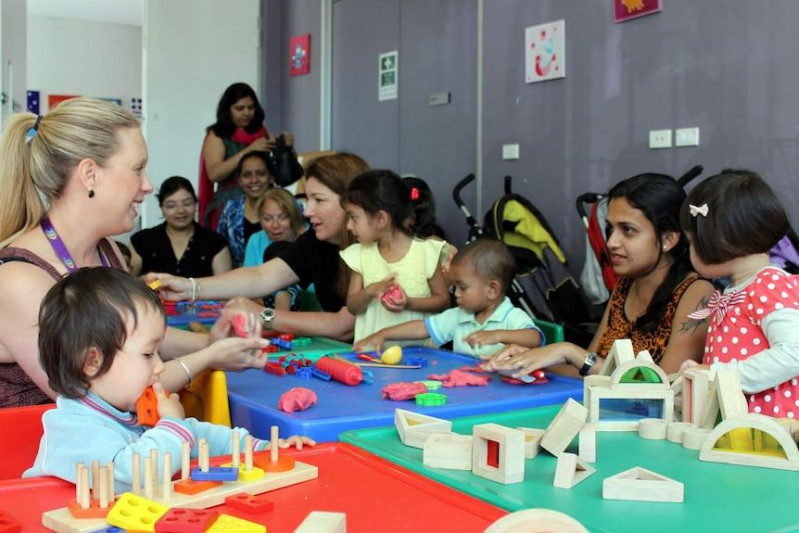
In Bronfenbrenner's (1979) macrosystem, families' values and attitudes within the society influence the way they are welcomed by services and the community. Enrolment in quality, culturally appropriate early learning is correlated with being developmentally on track at school entry for First Nations children (AIHW, 2025c), but may be lower than rates for non-Indigenous children and is related to the lack of culturally safe services and the historical mistrust of institutions. Disruption to education, exposure to trauma, and learning English as an additional language may impact refugee/immigrant children's communication, social confidence and emotional regulation. Vygotsky's (1978) idea of the zone of proximal development emphasizes culturally and linguistically responsive scaffolding, as learning takes place through the language and cultural tools already available to the child. Both groups may be marginalised in services that are rooted in and reflect dominant Anglo-Australian values, highlighting the need for practice that is inclusive and strengths-based. To make matters worse, a large Australian cohort study revealed that both premigration adversity and postmigration stressors of settlement had an association with poor psychosocial health in refugee children, suggesting that there is a need for support to reach beyond the point of migration (Guo et al., 2023). Likewise, this is an ongoing process of engagement with Aboriginal and Torres Strait Islander knowledge holders, not a one-off consultation, that has been found to support the development of culturally responsive educator practice (Kickett-Tucker et al., 2025).
Social Policy and Australian Responses
The Outcomes for First Nations early learning are included in the National Agreement on Closing the Gap: 95% of preschool children enrolled (Department of Education, 2026); improved developmental outcomes (AIHW, 2025c). A significant access barrier was removed; starting from January 2026, Aboriginal and Torres Strait Islander families received 100 subsidised Child Care Subsidy hours per fortnight, irrespective of activity (Department of Education, 2026). Connected Beginnings is an alliance of health, family support and early learning services with community-controlled organisations. Settlement Services International and Foundation House provide trauma-informed settlement services for refugee and immigrant families, and Foundation House's Early Years Learning Framework V2.0 (AGDE, 2022) places cultural and linguistic diversity as a key priority for educators to celebrate and acknowledge, including First Nations perspectives. As a result of the ongoing overrepresentation of First Nations children in out-of-home care, SNAICC's Family Matters campaign remains ongoing to advocate on the ATSICPP and community-controlled early years services. For refugee families, Australian research has identified culturally credible early childhood services, in which staff actively build trust with refugee families, as trauma-recovery environments (Lamb, 2020), and trauma-informed, relational strategies to support refugee families are being increasingly promoted in the broader Australian education sector (Baker & Naidoo, 2024).
Strategies for Practice
- Acknowledge and incorporate First Nations perspectives every day - not just as a token item along the way.
- Use and present important words in other languages, e.g., families' home language; invite families to sing, read, and say greetings in their home language; language is central to learning (Vygotsky, 1978).
- Refugee and immigrant families: culturally responsive family partnerships (use of interpreters, flexible orientation processes, visual communication).
- Aboriginal or Torres Strait Islander communities' involvement as community elders and cultural mentors: involve Aboriginal and Torres Strait Islander Elders or cultural workers in co-designing experiences.
- Orients with a trauma-aware, strengths-based approach: includes taking time to understand each family's migration story without soliciting disclosure, emphasizing strengths and resettlement goals.
Community and Professional Partnerships
- SNAICC -National Voice for our Children -the peak body for Aboriginal and Torres Strait Islander children.
- Community Controlled: Connected Beginnings -integrated early years and community-controlled service partnership.
- FHS- trauma-informed support for refugee families (Victorian Foundation for Survivors of Torture).
- Settlement Services International (SSI) -settlement, casework and community support for migrant and refugee families.
- AMES Australia is an English language and settlement service for newly arrived families.
These materials provide a reflection of their own culture and language to First Nations and refugee and/or immigrant children and provide an opportunity for all children to develop empathy, curiosity and respect for cultural differences as a strength and a way of life.
Resources for Educators and Children
Projects, Programs and Websites
-
SNAICC (snaicc.org.au)
-
Connected Beginnings (education.gov.au)
-
Foundation House School Support Program (foundationhouse.org.au)
-
Reconciliation Australia classroom and early years resources.
Children's Storybooks (Birth- 5 Years)
- Welcome to Country -Aunty Joy Murphy & Lisa Kennedy
- Family -Aunty Fay Muir & Sue Lawson
- My Two Blankets- Irena Kobald & Freya Blackwood
- Mirror -Jeannie Baker
These resources allow for normalisation of big emotions and tough family things in age-appropriate ways and provide a language for children to communicate feelings and a gentle entry point for developing empathy, trust and resilience in the educator.
Videos, Shows and Podcasts
Critical Reflection
Cultural inclusion can be empty, symbolic, an Acknowledgement of Country without action (Acker & Nyland, 2025), rather than ongoing practice. However, the needs of refugee families do not stop after they have been housed and translated, and psychosocial needs are experienced well beyond the resettlement phase (Guo et al., 2023).
Reference Lists (APA 7th Edition)
Acker, A., & Nyland, B. (2025). Early childhood pedagogy, human values and the social contract. Contemporary Issues in Early Childhood. Advance online publication. https://doi.org/10.1177/14639491241308593
Australian Government Department of Education. (2022). Belonging, being and becoming: The Early Years Learning Framework for Australia V2.0. Australian Government Department of Education.
Australian Institute of Health and Welfare. (2025c). Aboriginal and Torres Strait Islander children: Overview. AIHW, Australian Government.
Baker, S., Naidoo, L. Developing trauma-informed university supports for refugee background students in Australia: Refocusing through an ethics of care lens. Aust. Educ. Res. 51, 799–814 (2024). https://doi.org/10.1007/s13384-023-00625-9
Bronfenbrenner, U. (1979). The ecology of human development: Experiments by nature and design. Harvard University Press.
Department of Education. (2026). Closing the Gap: Early childhood education outcomes for First Nations children. Australian Government.
Foundation House. (n.d.). Our programs. https://foundationhouse.org.au/specialised-programs/
Guo, S., Nguyen, H., Lin, J., & Slewa-Younan, S. (2023). Premigration and postmigration factors associated with psychosocial wellbeing among refugee children and adolescents in Australia: A systematic review. (Please verify exact journal/volume details.)
Kickett-Tucker, C., Dodd, J., Coffin, J., Johnson, D., Cross, D., & Karangaroa, S. (2025). Educating the educated: Embracing respectful responsibility. Australian Journal of Education. https://doi.org/10.1177/00049441251321532.
Lamb, C. (2020). Culturally credible early childhood services as trauma-recovery environments for refugee families.
SNAICC – National Voice for our Children. (n.d.). SNAICC. https://www.snaicc.org.au/
Vygotsky, L. S. (1978). Mind in society: The development of higher psychological processes. Harvard University Press.