
Economic Contexts
Understanding the Context
Economic hardship (Poverty, Housing Stress and Financial Hardship) is a significant and widespread context impacting the early years of Australian children. Poverty is not just a lack of money; it is also a lack of participation in the common lifestyle and common customs of the people (Davidson & Bradbury, 2025). The national data indicates that around 757,000 (1 in 6) children under 15 years of age were living in poverty in 2025, and this has increased significantly since the end of pandemic-era income supports and the rising cost of living (Davidson & Bradbury, 2025). Housing stress exacerbates this burden as families often have to allocate a larger proportion of their income to housing costs and, as a result, have limited funds available for food, healthcare, and early learning resources. Both structural explanations (labour market insecurity, income support, housing affordability) and relative-deprivation explanations (social exclusion) are used to explain poverty in Australia. The distribution of poverty is not uniform; single-parent households and those that rely on income support are at greatest risk (Davidson & Bradbury, 2025), and this demonstrates the multi-layered and dynamic disadvantage within current Australian society. Bessell (2022) suggests that a capability lens on child poverty - how a child can do and can become – rather than income alone, can make early childhood services appear as places with the power to build capability, irrespective of household income.
Impact on Children and Families
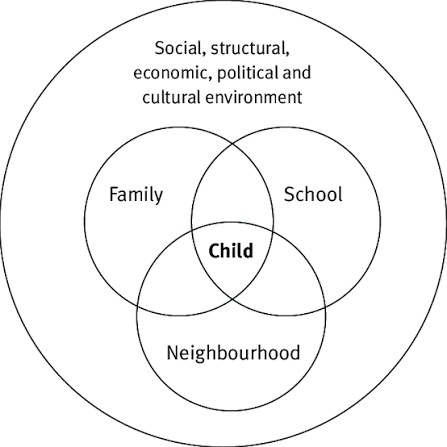
The Bronfenbrenner (1979) bioecological model is used to support the concept of how poverty can impact the resources children have access to in their microsystems (home, services) and in the connections between their microsystems. Access to nutritious foods, stable housing, healthcare, and quality early learning programs is limited by financial hardship, and without meeting the physiological and safety needs at the bottom of Maslow's (1943) hierarchy, it will be hard for higher-order needs of belonging and self-actualisation to be addressed. Overcome by poverty, children are more likely to experience impaired language and cognitive development along with physical health and social-emotional challenges due to chronic stress within the family. Economic disadvantages may include non-attendance at school, outstanding fees, and a reluctance to attend services due to shame or past experiences in services institutions. Teachers need to be sensitive to the fact that hardship can affect the whole family system with an increase in family stress and therefore affect their capacity to engage in the sensitive and responsive interactions that are necessary for healthy development (Bowlby, 1969). Australian cohort research backs this up: housing insecurity and low housing affordability are found to have independent associations with poorer developmental outcomes at school entry (Villanueva et al., 2019); and community-level disadvantage magnifies the impact of individual family disadvantage on shaping children's developmental trajectories (Goldfeld et al., 2021).

Social Policy and Australian Responses
The Australian Government has acted on child poverty by increasing the rates of JobSeeker, Parenting Payment and Rent Assistance above the rate of inflation in 2023 (Davidson & Bradbury, 2025). Yet, the incomes of families living in poverty are, on average, 44% lower than for families that are not affected by these settings, showing that the current settings are still inadequate (Davidson & Bradbury, 2025). The National Quality Framework (ACECQA) and the Early Years Learning Framework V2.0 (AGDE, 2022) mandate that child care services plan inclusively for children from all socioeconomic backgrounds, whilst the Child Care Subsidy (CCS) and other child care subsidy provisions work to lower the cost barrier to access. ACOSS remains pressing for more time-linked poverty reduction goals and for an increase in the amount of social housing in Australia (Davidson & Bradbury, 2025), which is an area that continues to present a policy gap between intended outcomes and lived experiences for the increasing number of Australian families facing financial hardship.
Strategies for Practice
- Access to CCS and other subsidies: proactively assist families to gain access to CCS and other subsidies; keep the enrolment process transparent and free from judgement.
-
Embedded, no-cost resourcing: uniforms, food, art materials and excursion costs to be included in the program and no child made to feel unusable in terms of participation (EYLF Outcome 1: Identity).
-
Nutrition support: provide breakfast or morning tea program in collaboration with Foodbank Australia to overcome the physiological impediments to learning proposed by Maslow (1943).
-
Facilitate relationships between families and their strengths, relationships that are not stigmatising, that normalise talking about financial pressure and proactively link families with support services (Bronfenbrenner's mesosystem).
-
Low-cost, high-quality routines: Ensure that the quality of the curriculum is not based on family purchasing power by using play opportunities using items around the house and nature materials.
Community and Professional Partnerships
-
The Smith Family - offers the Learning for Life program, which includes financial scholarships and mentoring for children of low-income families.
-
Anglicare Australia - Emergency relief services, financial counselling and family support services.
-
Foodbank Australia - provides breakfast programs in schools and services to address food insecurity.
-
Infoxchange (Ask Izzy) - a free digital directory connecting families with local housing, food and financial-assistance services.
-
National Debt Helpline financial counsellors: free and confidential advice for families who are facing financial difficulties and are available for educators to refer families to.
Resources for Educators and Children
Projects, Programs and Websites
- The Smith Family - Learning for Life (thesmithfamily.com.au)
- Raising Children Network - Money and Financial Stress hub (raisingchildren.net.au)
- Foodbank Australia School Breakfast Program (foodbank.org.au)
- Ask Izzy (askizzy.org.au)
Children's Storybooks (Birth - 5 Years)
- A Chair for My Mother - Vera B. Williams
- Those Shoes - Maribeth Boelts
- Fly Away Home - Eve Bunting
- The Can Man - Laura E. Williams
These resources provide children with an age-appropriate reflection of their own experiences of adversity without condemnation, and for educators, a common language that will help to foster empathy, normalize different families' experiences, and demonstrate resilience and hope to the group.
Videos, Shows and Podcasts
Critical Reflection
Despite an increase in income support, people in families at risk of or living below the poverty line are still 44% behind people in other families (Davidson & Bradbury, 2025), meaning policy is dealing with hardship, not solving it. Services need to consider their own hidden costs, fees, uniforms, excursions before assuming that it's a family issue is only an issue with the family.
References List (APA 7th Edition)
Australian Children's Education and Care Quality Authority. (n.d.). National Quality Framework. https://www.acecqa.gov.au/national-quality-framework
Australian Government Department of Education. (2022). Belonging, being and becoming: The Early Years Learning Framework for Australia (Version 2.0).
Bessell, S. (2022). Rethinking child poverty. Journal of Human Development and Capabilities, 23(4), 539–561. https://doi.org/10.1080/19452829.2021.1911969
Bowlby, J. (1969). Attachment and loss: Vol. 1. Attachment. Basic Books.
Bronfenbrenner, U. (1979). The ecology of human development: Experiments by nature and design. Harvard University Press.
Davidson, P., & Bradbury, B. (2025). Poverty in Australia 2025: Overview. Australian Council of Social Service and UNSW Sydney. https://povertyandinequality.acoss.org.au/poverty_in_australia_2025_overview/
Goldfeld, S., Villanueva, K., Tanton, R., Katz, I., Brinkman, S., Giles-Corti, B., & Woolcock, G. (2021). Findings from the Kids in Communities Study (KiCS). PLOS ONE, 16(9), e0256431. https://doi.org/10.1371/journal.pone.0256431
Maslow, A. H. (1943). A theory of human motivation. Psychological Review, 50(4), 370–396. https://doi.org/10.1037/h0054346
Raising Children Network. (n.d.). Money and financial stress.
https://raisingchildren.net.au/grown-ups/family-life/finances/money-and-financial-stress
The Smith Family. (n.d.). Learning for Life.
https://www.thesmithfamily.com.au/programs/learning-for-life
Villanueva, K., Badland, H., Tanton, R., Katz, I., Brinkman, S., Lee, J.-L., Woolcock, G., Giles-Corti, B., & Goldfeld, S. (2019). Local housing characteristics associated with early childhood development outcomes in Australian disadvantaged communities. International Journal of Environmental Research and Public Health, 16(10), 1719. https://doi.org/10.3390/ijerph16101719